

Travel Insurance Market Set to Surpass USD 108.89 Billion by 2035 Amid Rising Global Tourism
Travel Insurance Market
Travel Insurance Market Size, Share and Research Report By Insurance Cover (Single-Trip Travel Insurance, Annual Multi-Trip Travel Insurance, and Long-Stay)
The travel insurance market is witnessing steady growth as global tourism rebounds and travelers increasingly seek financial protection against trip cancellations and medical emergencies.”
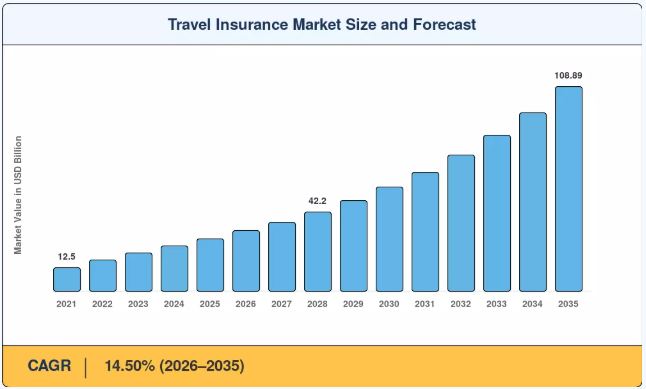
PARIS, PARIS, FRANCE, June 26, 2026 /EINPresswire.com/ -- The Global Travel Insurance market was valued at USD 27.80 billion in 2025 and is projected to grow from USD 32.19 billion in 2026 to USD 108.89 billion by 2035, registering a compound annual growth rate (CAGR) of 14.50% during the forecast period. Travel insurance encompassing single-trip and annual multi-trip policies covering medical emergencies, trip cancellation, baggage loss, travel delays, and emergency evacuation is transitioning from a discretionary travel add-on into a foundational component of the modern travel planning experience. — Market Research Future (MRFR)
According to the World Health Organization, approximately 1.5 billion people travel internationally each year, a figure anticipated to grow steadily over the forecast decade as rising disposable incomes, the expansion of budget airline networks, and the post-pandemic normalization of international travel fuel sustained demand for financial travel protection globally.
Two structural catalysts anchor this market’s growth trajectory: government mandates requiring travel insurance as a condition of visa issuance most notably the Schengen Area’s minimum EUR 30,000 medical coverage requirement covering 27 European countries and the rapid digitalization of insurance distribution through online aggregators, embedded checkout journeys, and mobile-first policy platforms.
International tourism revenues surpassed the USD 1 trillion threshold again in 2022 and have continued to grow, expanding the pool of insurable travel events and driving both mandatory and voluntary travel insurance policy uptake. Heightened traveler awareness of medical, cancellation, and geopolitical risks following the COVID-19 pandemic has durably shifted consumer attitudes toward comprehensive coverage, elevating the market’s long-term growth floor.
Get Full PDF Sample Copy of Report: (Including Full TOC, List of Tables & Figures, Chart) @
https://www.marketresearchfuture.com/sample_request/11161
➤ How Significant Is the Travel Insurance Market’s Growth?
This nearly three-fold expansion over the forecast decade reflects the convergence of rising global travel volumes, mandatory insurance legislation across an expanding roster of visa destinations, and a fundamental shift in traveler behavior toward treating comprehensive travel protection as a non-negotiable component of international trip planning.
Single-trip insurance dominated the insurance cover segment with a 58% revenue share, reflecting the preference of occasional travelers for per-trip rather than subscription-based coverage. The family travelers end-user segment commanded 60% of market revenue, underscoring the risk-awareness premium placed on protecting group travel investments, while the 18–30 age group led demographic demand with a 60% market share, reflecting the outsize role of millennial and Gen Z travelers in driving global travel volume growth.
North America held the largest regional market share in 2025, anchored by high travel expenditure and widespread institutional insurance adoption, while Asia-Pacific is forecast to expand at the fastest regional CAGR, driven by a rapidly growing middle class, expanding outbound tourism markets in China and India, and increasing awareness of travel-related financial risks.
➤ What Does the Future Hold for the Travel Insurance Market?
Government mandates and regulatory frameworks are establishing expanding compliance-driven demand floors for the market. More than 60 countries now require proof of travel insurance with minimum medical coverage as a visa application condition, and the EU’s Schengen Area requirement for EUR 30,000 minimum medical coverage is enforced across 27 member states collectively representing hundreds of millions of mandatory policy purchases annually. As additional destinations in Southeast Asia, the Middle East, and Latin America implement comparable requirements to protect both visitors and domestic healthcare systems, the addressable market for mandatory travel insurance is expanding structurally year over year.
Digital platform innovation is fundamentally transforming how travel insurance reaches consumers and how claims are processed. Embedded insurance at airline, hotel, online travel agency, and ride-hailing checkout journeys is achieving dramatically higher attachment rates than standalone policy distribution a model that simultaneously improves customer convenience and provides insurers access to granular, trip-specific data that enhances underwriting accuracy.
Parametric travel insurance products which trigger automatic payouts for defined events such as flight delays exceeding specified thresholds without requiring claimant documentation are gaining significant traction, with providers including Allianz and AXA deploying automated claims settlement systems that improve customer satisfaction scores and reduce claims processing costs simultaneously.
Artificial intelligence and personalization are reshaping travel insurance product design, distribution, and claims management. Machine-learning models incorporating destination-specific risk indicators, traveler age profiles, trip duration, and declared medical information are enabling dynamic coverage customization and real-time pricing adjustments that move beyond the standardized exclusions of legacy policy structures.
AI-driven claims automation is compressing settlement timelines from weeks to hours for straightforward medical and cancellation claims, and telemedicine integration within comprehensive travel policies is enabling cost-effective early medical intervention that reduces claim severity for insurers while providing high-value real-time health support for policyholders in unfamiliar healthcare environments abroad.
➤ Who Are the Key Players in the Travel Insurance Market?
The travel insurance market is served by a combination of global insurance conglomerates with dedicated travel assistance divisions, specialist travel insurance brands, and digital-native insurance platforms. MRFR identifies the following key participants shaping the competitive landscape:
★Allianz SE — the world’s largest travel insurer by premium volume, operating through its Allianz Global Assistance and Allianz Travel divisions with embedded distribution partnerships spanning major airlines, online travel agencies, and retail insurance aggregators across more than 30 countries.
★American International Group, Inc. (AIG) — a global insurance leader offering comprehensive travel protection products through its AIG Travel and Travel Guard brands, serving both individual travelers and corporate travel risk management programs across North America, Europe, and Asia-Pacific.
★Travel Guard (AIG) — one of the most recognized travel insurance brands in North America, providing a broad range of single-trip, annual multi-trip, and cancel-for-any-reason (CFAR) policies with 24/7 emergency assistance services for leisure and business travelers.
★AXA SA — a major global insurance group with significant travel insurance operations through AXA Assistance and AXA Travel Insurance, offering medical expense, trip cancellation, and comprehensive coverage products distributed through direct digital channels and travel partner integrations.
★Berkshire Hathaway Specialty Insurance — a financially-rated travel insurance provider leveraging Berkshire Hathaway’s balance sheet strength to offer premium travel protection products targeting high-value trips, luxury travelers, and complex itinerary coverage requirements.
★Chubb Limited — a global insurance leader providing comprehensive travel insurance products, including high-limit medical coverage, adventure sports coverage, and corporate travel risk programs through direct, broker, and embedded distribution partnerships.
★InsureandGo — a leading UK-based specialist travel insurance provider offering accessible single-trip and annual multi-trip policies through direct online distribution, with particular strength in serving the European leisure travel market with pre-existing medical condition coverage options.
★World Nomads Group — a specialist travel insurance provider targeting adventurous travelers and digital nomads, with flexible, customizable coverage extending to extreme sports, remote destination medical evacuation, and trip extensions, distributed through a digital-first platform model.
★Generali Global Assistance — the travel insurance and assistance division of Assicurazioni Generali S.p.A., providing comprehensive travel protection and emergency assistance services through airline, tour operator, and financial institution partnership distribution channels globally.
Competitive dynamics in this market are increasingly shaped by the race to establish embedded distribution partnerships with high-volume travel booking platforms, the deployment of AI-driven personalized pricing and automated claims settlement, and the development of parametric and CFAR product innovations that address the post-pandemic shift in traveler risk appetite toward more comprehensive and flexible coverage.
➤ What Are the Emerging Trends in the Travel Insurance Market?
Several transformational trends are redefining the travel insurance market’s evolution through 2035:
Government Visa Mandates Expanding the Compliance Market: More than 60 countries now mandate minimum travel insurance as a visa condition, with the EU Schengen Area’s EUR 30,000 medical coverage requirement representing the most significant mandatory demand driver globally. As additional destinations in Southeast Asia, the Gulf Cooperation Council, and Latin America implement comparable requirements, the mandatory travel insurance market is expanding structurally year over year.
Embedded Insurance at Travel Checkout Driving Attachment Rates: Distribution of travel policies directly within airline, online travel agency, hotel, and cruise booking checkout flows is achieving materially higher purchase rates than standalone and post-booking distribution, establishing embedded travel insurance as the dominant growth channel and reshaping insurer partnership strategies with travel commerce platforms.
Parametric & CFAR Innovation Addressing Post-Pandemic Risk Aversion: Parametric policies that automatically settle claims for defined events — including flight delays, destination weather disruptions, and airline bankruptcies — without requiring documentation are gaining consumer acceptance. Cancel-for-any-reason (CFAR) add-on riders, which surged in demand following the COVID-19 pandemic, have been permanently elevated in market share as travelers prioritize booking flexibility protection.
AI-Driven Personalization & Dynamic Pricing: Machine-learning underwriting engines that incorporate destination-specific risk scores, traveler health data, trip duration, and real-time geopolitical risk signals are enabling insurers to offer personalized coverage structures at dynamically adjusted price points, improving both risk selection accuracy and conversion rates through more relevant policy offerings.
Telemedicine & Global Medical Assistance Integration: Leading travel insurers are embedding telemedicine consultation, real-time medical guidance, and worldwide hospital network access within standard policy benefits, shifting travel insurance from a pure financial indemnity product toward a comprehensive travel support and health assistance platform that provides tangible value before, during, and after travel.
Asia-Pacific First-Time Buyer Opportunity: Hundreds of millions of first-time international travelers in China, India, Southeast Asia, and South Korea are entering the global travel market, representing a structurally significant new buyer cohort for travel insurance. Rising disposable incomes, growing outbound tourism, and increasing awareness of medical costs abroad are driving first-purchase travel policy adoption across the region at rates that are expected to sustain Asia-Pacific’s position as the fastest-growing regional market through 2035.
Get access to the full description of the report @
https://www.marketresearchfuture.com/reports/travel-insurance-market-11161
➤ How Is the Travel Insurance Market Segmented?
The travel insurance market report provides a comprehensive segmentation framework:
By Insurance Cover: Single-Trip Travel Insurance, Annual Multi-Trip Travel Insurance, Long-Stay/Extended Travel Insurance
By Distribution Channel: Insurance Intermediaries/Agents, Banks & Credit Institutions, Online Aggregators/Direct Digital, Travel Agencies & Tour Operators, Airline & Transport Operators
By End User: Family Travelers, Senior Travelers, Education Travelers, Business Travelers, Adventure/Solo Travelers
By Coverage Type: Medical & Accident Insurance, Trip Cancellation & Interruption, Baggage & Personal Belongings, Emergency Evacuation, Cancel-For-Any-Reason (CFAR)
By Region: North America, Europe, Asia-Pacific, South America, Middle East and Africa
➤ What Are the Regional Insights from the Travel Insurance Market?
North America commands the largest share of the global travel insurance market, supported by high per-capita travel expenditure, widespread consumer familiarity with insurance products, and robust corporate travel risk management programs that mandate comprehensive coverage for business travelers. The United States is the primary demand engine, home to major insurers including AIG’s Travel Guard, Berkshire Hathaway Specialty Insurance, and Chubb’s travel division, as well as a mature online travel agency ecosystem that drives embedded insurance attachment at scale. High average trip values among North American outbound travelers support premium policy pricing that reinforces the region’s revenue leadership.
Europe holds the second-largest regional share, anchored by the Schengen Area’s mandatory EUR 30,000 medical coverage requirement that creates a guaranteed baseline policy demand across 27 member states. The United Kingdom, Germany, France, and the Nordic countries are the primary market drivers, with high outbound leisure travel frequency and well-established broker and aggregator distribution infrastructure. The UK’s InsureandGo, Germany’s ERGO Travel Insurance, and Allianz’s European travel divisions collectively serve a mature market in which policy renewal rates and annual multi-trip adoption are among the highest globally.
Asia-Pacific is the fastest-growing regional market for travel insurance, driven by the emergence of hundreds of millions of first-time international travelers across China, India, Indonesia, and Southeast Asia. China’s outbound tourism market — the world’s largest by expenditure pre-pandemic and recovering rapidly through 2025 represents the single most significant demand growth opportunity in the global travel insurance market. India’s rising middle class and government-encouraged outbound travel, combined with increasing awareness of healthcare costs abroad, are establishing the subcontinent as a structurally significant long-term growth market. Japan and South Korea’s mature, high-frequency outbound travel bases further reinforce Asia-Pacific’s exceptional growth trajectory.
South America and the Middle East & Africa represent emerging growth markets for travel insurance, with adoption increasingly driven by outbound leisure tourism growth from Brazil and Mexico, corporate travel programs in the Gulf Cooperation Council states, and the gradual expansion of mandatory coverage requirements across new visa destinations. While currently representing smaller shares of global premium volume, rising disposable incomes, growing airline network connectivity, and expanding insurance distribution infrastructure across these regions are expected to support above-average growth rates through 2035.
➤➤➤ Industry Analysis Reports by Market Research Future:
India Video Surveillance Systems Market-
https://www.marketresearchfuture.com/reports/india-video-surveillance-systems-market-20720
Us Graphics Processing Unit Market-
https://www.marketresearchfuture.com/reports/us-graphics-processing-unit-market-21206
Streaming Devices Market
https://www.marketresearchfuture.com/reports/streaming-devices-market-21745
Japan Semiconductor Device Market-
https://www.marketresearchfuture.com/reports/japan-semiconductor-device-market-21777
Asia Pacific Consumer Electronics Market-
https://www.marketresearchfuture.com/reports/asia-pacific-consumer-electronics-market-21781
Memory & Processors For Military And Aerospace Applications Market-
https://www.marketresearchfuture.com/reports/memory-processors-for-military-aerospace-applications-market-22194
Fintech Lending Market-
https://www.marketresearchfuture.com/reports/fintech-lending-market-22833
Crowdfunding Market-
https://www.marketresearchfuture.com/reports/crowdfunding-market-22857
Student Loan Market-
https://www.marketresearchfuture.com/reports/student-loan-market-22878
Islamic Finance Market-
https://www.marketresearchfuture.com/reports/islamic-finance-market-23027
Sagar Kadam
Market Research Future
+ +1 628-258-0071
email us here
Legal Disclaimer:
EIN Presswire provides this news content "as is" without warranty of any kind. We do not accept any responsibility or liability for the accuracy, content, images, videos, licenses, completeness, legality, or reliability of the information contained in this article. If you have any complaints or copyright issues related to this article, kindly contact the author above.
